

Exploring the Invisible Hand of Artificial Intelligence in Daily Life
Artificial Intelligence (AI) is often portrayed as a futuristic technology driving self-driving cars, humanoid robots, and space exploration. But in reality, artificial intelligence is already deeply embedded in our daily lives, and many of us use it without even realizing it. Whether you are browsing the web, shopping online, or navigating traffic, AI is quietly working behind the scenes to make things smoother and smarter.
From the origin of AI in the mid-20th century to the highly advanced artificial intelligence tools we rely on today, this field has grown rapidly.
In this blog, we shall break down what AI actually is, whether we can truly trust it, and explore the top 5 examples of artificial intelligence you likely use every day—often without knowing it.
What Is Artificial Intelligence?

Artificial Intelligence refers to computer systems that are designed to mimic human intelligence. These systems can learn from data, recognize patterns, make decisions, and even understand natural language.
AI is not just one technology—it is a collection of methods, including machine learning, deep learning, neural networks, and natural language processing.
The artificial intelligence origin dates back to the 1950s, with early pioneers laying the foundation. Since then, the field has evolved dramatically, especially with the explosion of data and improvements in computing power.
Today, artificial intelligence tools are everywhere: in smartphones, search engines, recommendation systems, and even public infrastructure.
Can We Trust Artificial Intelligence in Daily Life?

This is a vital question in today is AI-powered world. While artificial intelligence in daily life can enhance convenience and productivity, it also brings legitimate concerns about transparency, fairness, and safety. Here are some key aspects to consider when evaluating trust in AI:
- Efficiency and Accuracy: AI systems can handle tasks faster and more accurately than humans in many cases, such as data analysis, medical imaging, or traffic control.
- 24/7 Availability: Unlike humans, AI does not need breaks or sleep, making it ideal for customer service, monitoring, and real-time data analysis.
- Personalization: AI adapts to your preferences, whether it is in your Netflix recommendations, shopping suggestions, or voice assistant behavior.
- Bias in Data: If the data used to train an AI system is biased, the AI will likely reflect and even amplify those biases.
- Lack of Transparency: Many AI systems, especially those using deep learning, operate as “black boxes,” making it hard to understand how they reach decisions.
- Privacy Issues: AI often relies on large datasets, some of which include sensitive personal information, raising concerns about data misuse.
- Over-reliance: As AI becomes more integrated, there is a risk of people becoming overly dependent on it, potentially losing critical thinking skills or control in key areas.
- Security Risks: AI systems can be vulnerable to attacks or manipulation, especially in areas like finance or autonomous vehicles.
So, can we trust AI?
The answer is: with caution and responsibility. We must build ethical frameworks, ensure transparency, and enforce strict data protection regulations to make AI truly trustworthy.
5 Everyday Uses of AI You Did not Realize You Use
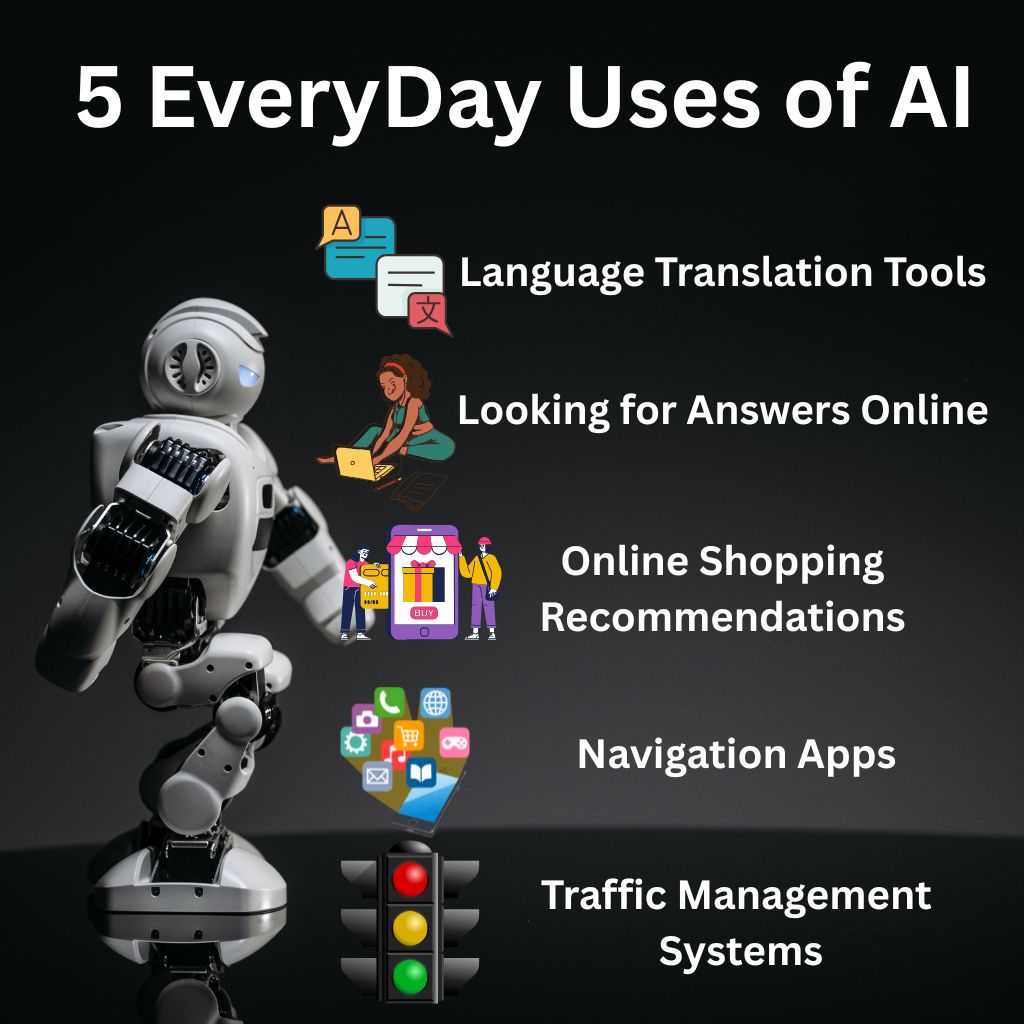
Are you using any AI tools you did not even realize? —we are here to explore AI together.
AI is not just powering cutting-edge technology — it is also helping with everyday problems in surprisingly subtle ways. Let is look at five common examples of artificial intelligence in daily life that often go unnoticed:
1. Language Translation Tools
Have you ever used Google Translate or real-time captioning features during a meeting? AI is at the core of these services. By combining deep learning and natural language processing, AI can translate spoken or written language almost instantly. It also adjusts translations based on context and usage patterns, improving over time.
These tools break down language barriers for travelers, international business professionals, students, and global teams, making cross-cultural communication more accessible than ever.
2. Looking for Answers Online
When you type a question into a search engine, AI is behind the magic that brings you relevant results. Search engines use AI algorithms to analyze your query, assess your intent, and rank results based on usefulness and accuracy. AI also powers voice-based queries in digital assistants like Siri, Alexa, and Google Assistant.
Even those helpful “People also ask” or “Did you mean?” suggestions are driven by machine learning models analyzing billions of user queries.
3. Online Shopping Recommendations
Ever wondered how Amazon knows exactly what you want to buy next? Or why Instagram shows you just the right ad at the right time?
That is artificial intelligence at work. AI tools track your browsing behavior, past purchases, likes, and preferences to deliver personalized product suggestions and targeted ads. Retailers also use AI to manage inventory, predict demand, and handle customer service via chatbots.
Thanks to AI, your online shopping experience is faster, more relevant, and sometimes eerily spot-on.
4. Navigation Apps
Apps like Google Maps, Waze, and Apple Maps rely heavily on artificial intelligence to help you get where you are going. They use real-time data from GPS, user inputs, and traffic reports to suggest the fastest, most efficient route.
AI even helps the app recalculate your route in real-time if there is an accident or roadblock. This ensures smoother commutes and improved time management for millions of drivers every day.
5. Traffic Management Systems
On a larger scale, AI plays a vital role in managing urban traffic. Many smart cities now use AI-powered traffic control systems that analyze sensor data to adjust traffic lights and reduce congestion. These systems can predict traffic flow, optimize signal timings, and help emergency vehicles navigate more efficiently.
The result? Fewer traffic jams, lower emissions, and safer roads.
Artificial Intelligence Conclusion
While we often associate artificial intelligence with robots or futuristic sci-fi, the reality is much closer to home. AI has become a silent assistant, helping us translate languages, find answers, shop smartly, navigate roads, and improve urban infrastructure.
Understanding the origin of artificial intelligence and how far it has come allows us to appreciate its benefits while staying aware of its risks. Trusting AI is not about blind faith—it is about responsible use, transparency, and ethical development.
As we continue to rely on artificial intelligence tools more and more, it is crucial to stay informed and engaged in conversations around their impact. After all, the future of AI is not just in machines — it is in how we choose to use it today.
Pingback: Top 5 Key Terms of AI You Should Know: Quick Guide
Pingback: Best AI tools for content writing in 2026: shape the future